Network Architecture · Infrastructure Analysis · Security

SNHUEnergy Network Evaluation

A network architecture evaluation examining communication between two offices and their shared business systems. The analysis maps infrastructure to the OSI model, documents VoIP and database traffic, identifies performance and security risks, and recommends improvements involving redundancy, segmentation, monitoring, and Quality of Service.

  • Network Analysis
  • Traffic Evaluation
  • OSI Model
  • Security
  • Performance Planning
  • Infrastructure Documentation
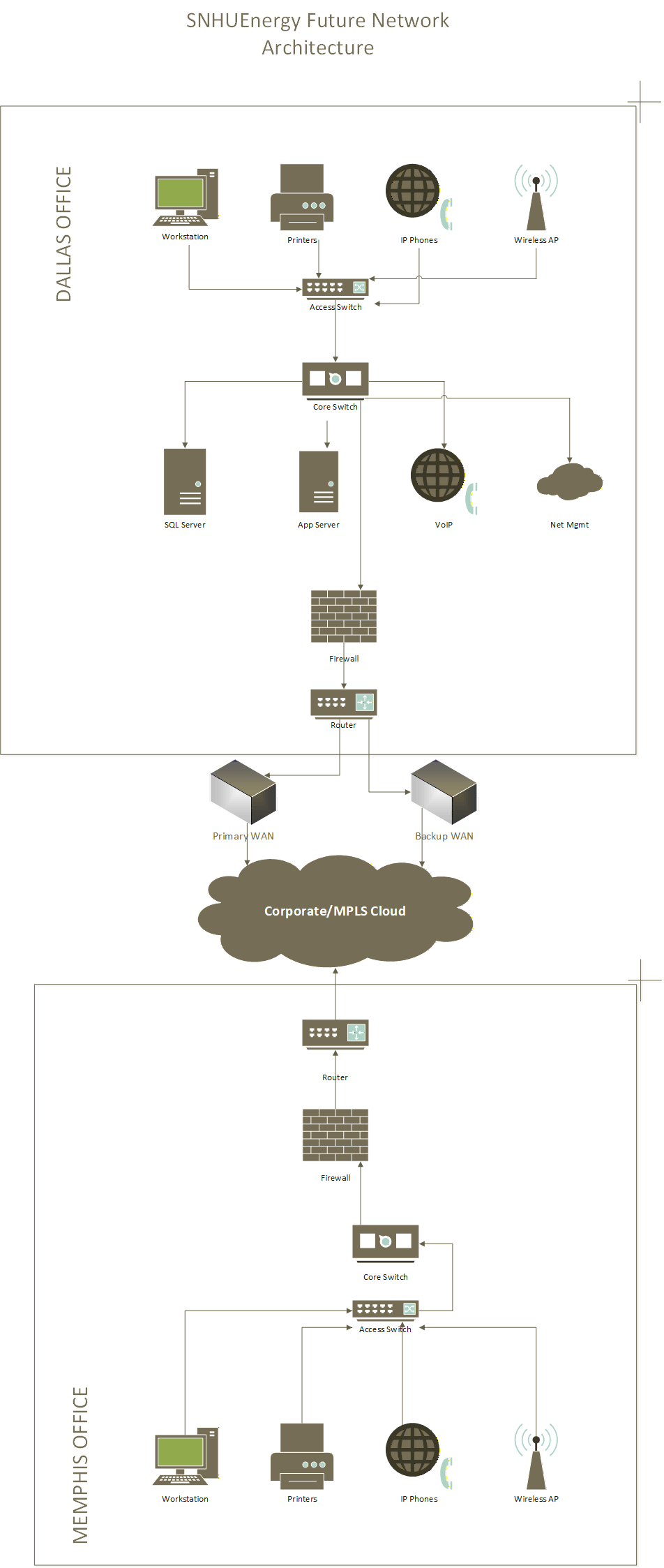
SNHUEnergy future network architecture connecting Dallas and Memphis offices
Proposed future-state network architecture

Project overview

Evaluating how infrastructure supports daily business operations

SNHUEnergy depends on its network infrastructure to support communication, business applications, databases, voice services, video conferencing, and collaboration between its Dallas and Memphis offices.

This project evaluates the current network from both technical and operational perspectives. I examined the role of network hardware, mapped communication to the OSI model, analyzed critical traffic patterns, identified reliability and security concerns, and developed recommendations for a more scalable future architecture.
Business environment

A shared network supporting two offices and multiple systems

01

Dallas

Dallas supports email, payroll, accounting, human resources, centralized database resources, and network-management functions.

02

Memphis

Memphis primarily supports billing and operations while relying on interoffice connectivity for access to shared resources.

03

Shared services

Both offices depend on VoIP, video conferencing, corporate computing, file access, internet connectivity, and other shared business services.

Current architecture

Documenting the existing network before recommending change

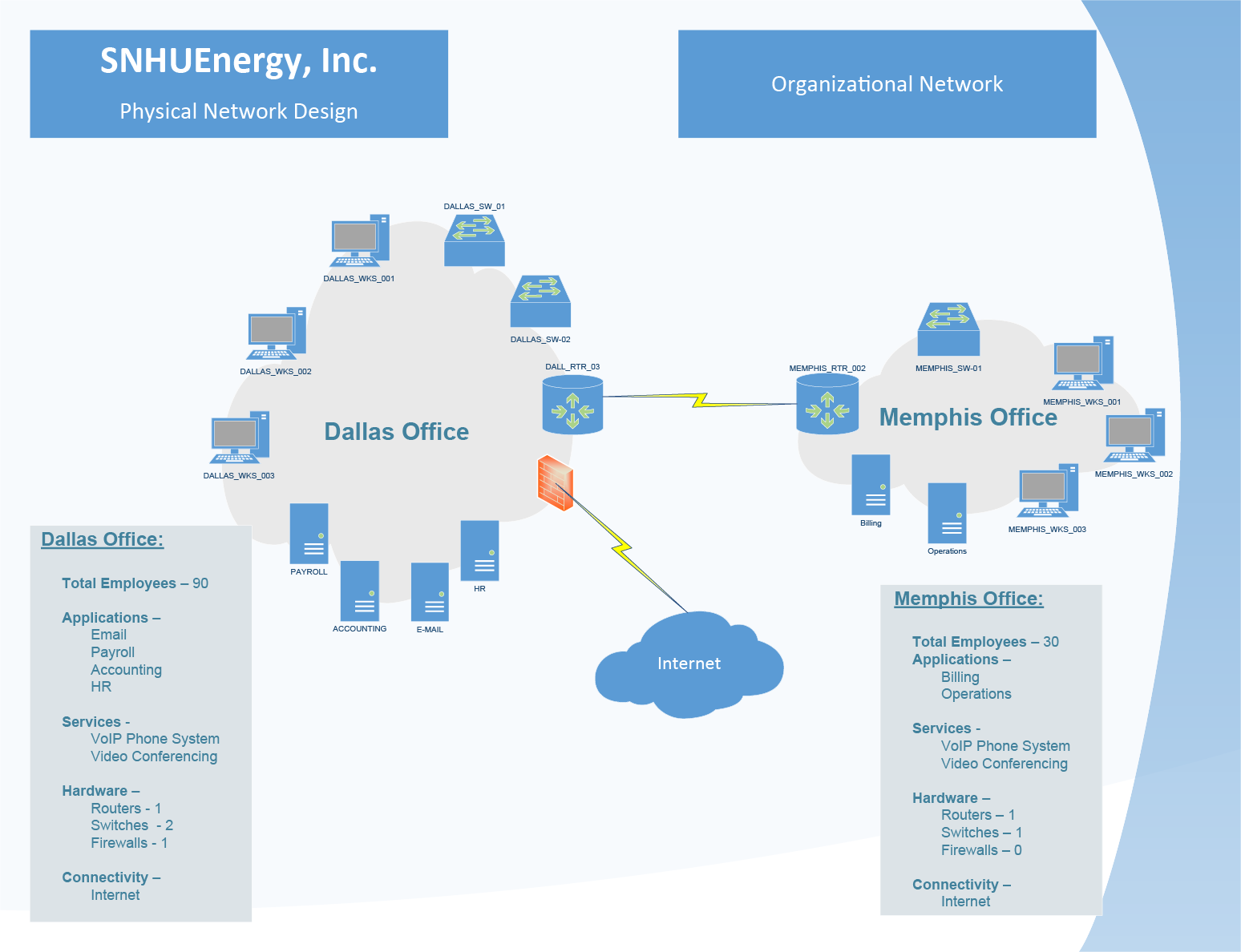
I first mapped the current infrastructure to understand how devices, offices, servers, and communication paths were connected.

SNHUEnergy organizational network diagram showing Dallas and Memphis offices
Organizational network High-level view of the Dallas and Memphis office infrastructure.
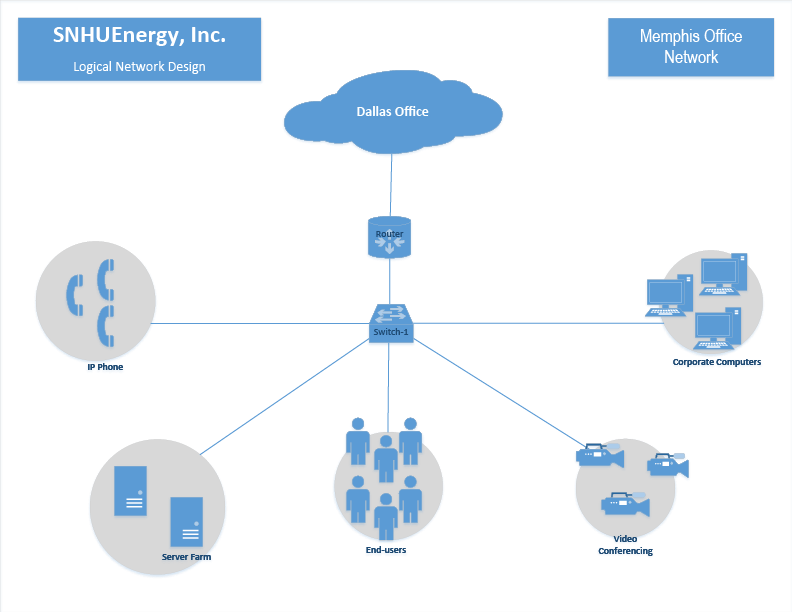
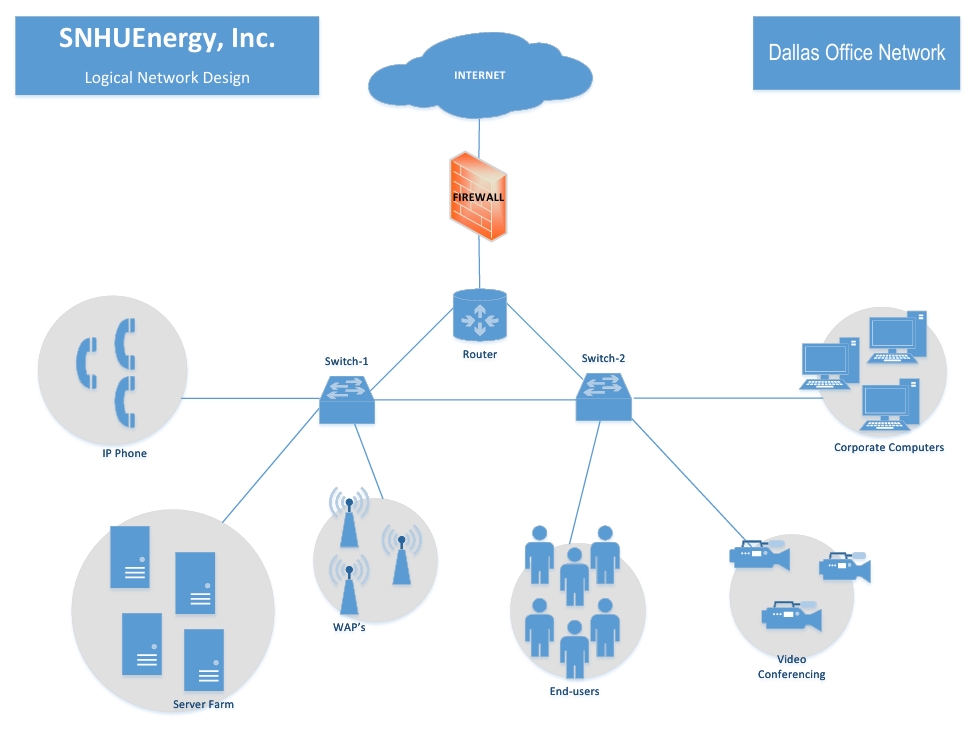
Current Dallas office network configuration
Dallas office Current logical network structure and connected services.
Current Memphis office network configuration
Memphis office Current office network showing its more limited infrastructure.

Physical network devices

Understanding the infrastructure behind the applications

The network uses routers, switches, firewalls, servers, wireless access points, workstations, printers, and IP phones to support communication across the organization.

Routers

Connect different networks and direct traffic between the Dallas and Memphis offices, the corporate WAN, and external resources.

Switches

Connect workstations, printers, phones, servers, and other devices within each local office network.

Firewalls

Monitor and filter traffic between trusted internal resources and external or interoffice networks.

Servers + wireless infrastructure

Support databases, administrative services, network management, applications, and mobile connectivity.

OSI model

Mapping infrastructure and communication across seven layers

The OSI model helped organize the network analysis by showing how physical equipment, addressing, transport protocols, secure connections, and business applications interact.

7

Application

Email, payroll, accounting, HR, billing, operations, VoIP, and collaboration applications.

6

Presentation

Data formatting, encryption, and representation between systems.

5

Session

Establishes and maintains communication sessions.

4

Transport

TCP and UDP support reliable or time-sensitive delivery.

3

Network

Routers direct traffic between local, WAN, and external networks.

2

Data Link

Switches manage communication among devices within each LAN.

1

Physical

Cabling, wireless access points, hardware connections, and interfaces.

Critical traffic

Following the traffic that keeps the organization running

01

VoIP traffic

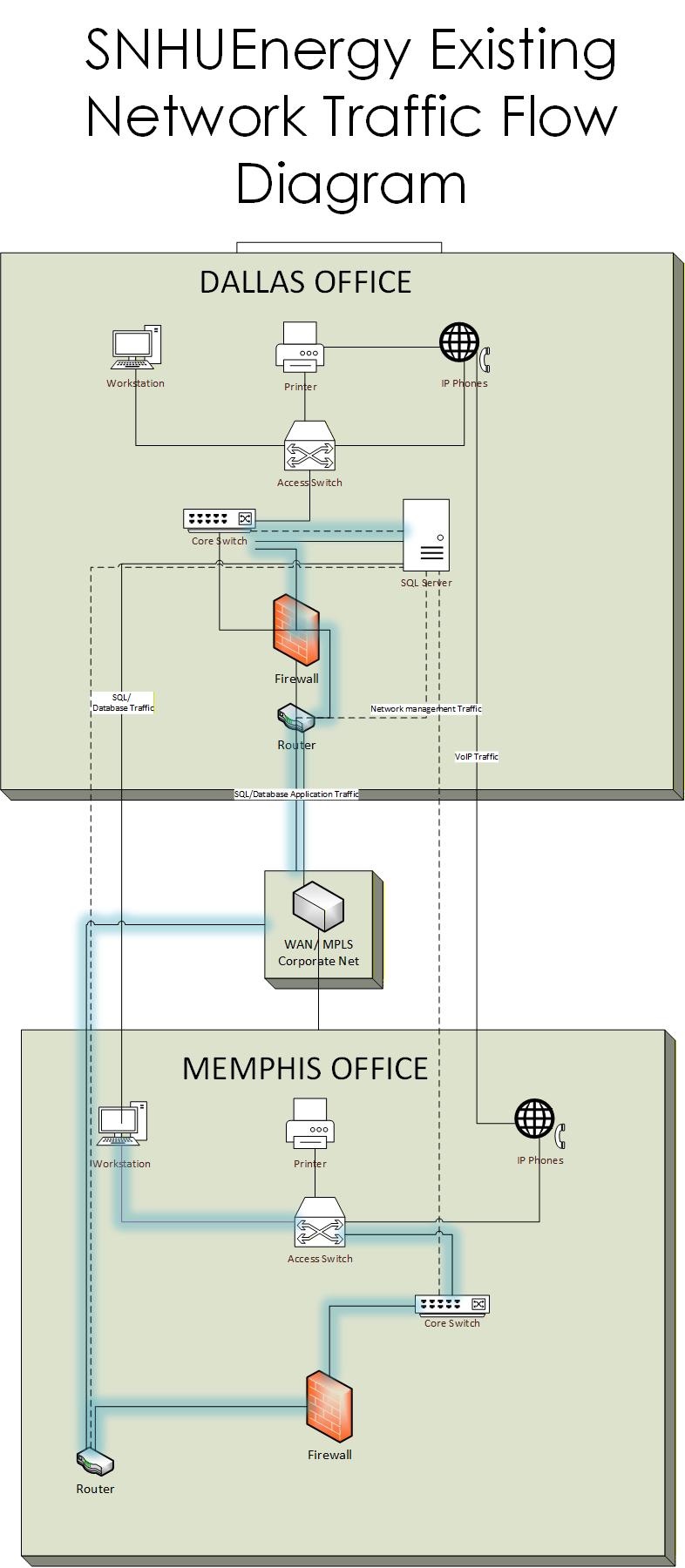
Voice traffic moves between office phones, switches, routers, and the interoffice network. Because VoIP is sensitive to latency, jitter, and packet loss, network consistency is essential for call quality.

02

SQL database traffic

The SQL server located in Dallas acts as a centralized business resource. Memphis users must send application requests across the WAN to access this data.

03

Network management

Monitoring systems collect logs, performance data, and device status information from infrastructure across both offices.

04

General business traffic

Email, file sharing, web browsing, cloud applications, and internal systems also contribute to overall bandwidth use.

End-to-end traffic flow

Visualizing how a request moves through the network

User Workstation Access Switch Core Switch Firewall Router WAN/MPLS Destination Network

SNHUEnergy existing network traffic flow between Dallas and Memphis offices
Existing network traffic flow showing SQL/database, VoIP, and network-management communication.

Findings

Performance and security risks in the current design

01

Single points of failure

Memphis relies heavily on a limited number of network devices. Failure of a router, switch, or interoffice connection could interrupt business operations.

02

WAN congestion

Increased traffic to centralized systems could create delays as the organization grows.

03

VoIP degradation

Without traffic prioritization, increased bandwidth use could lead to latency, jitter, packet loss, and reduced call quality.

04

Limited segmentation

Insufficient separation between user, server, voice, wireless, and administrative traffic can increase security exposure.

05

Uneven firewall protection

The current design gives Dallas stronger perimeter protection while Memphis appears to have less dedicated firewall coverage.

06

Monitoring limitations

Weak logging and monitoring could delay detection of suspicious activity, device failures, or performance problems.

Recommendations

Designing for resilience, security, and future growth

01

Add WAN redundancy

Provide backup WAN or internet connectivity so interoffice communication can continue during a primary connection failure.

02

Introduce VLAN segmentation

Separate user, voice, server, guest wireless, and management traffic into logical network segments.

03

Implement QoS

Prioritize VoIP and other latency-sensitive services over less time-sensitive traffic.

04

Improve security controls

Strengthen firewall coverage, internal access controls, patching, traffic filtering, and device security.

05

Strengthen monitoring

Centralize logs, device status, traffic monitoring, alerts, and performance analysis.

06

Scale centralized services

Protect and plan capacity for SQL, application, and management servers as user and traffic volumes increase.

Future-state architecture

Moving toward a more resilient network

The recommended design improves communication between Dallas and Memphis through better redundancy, traffic segmentation, centralized services, monitoring, security controls, and support for future growth.

Recommended SNHUEnergy future network architecture with redundant WAN connectivity
Proposed architecture connecting Dallas and Memphis through primary and backup WAN connectivity with structured switching, firewall protection, wireless access, and centralized services.

Network fundamentals

Connecting the detailed analysis to core networking concepts

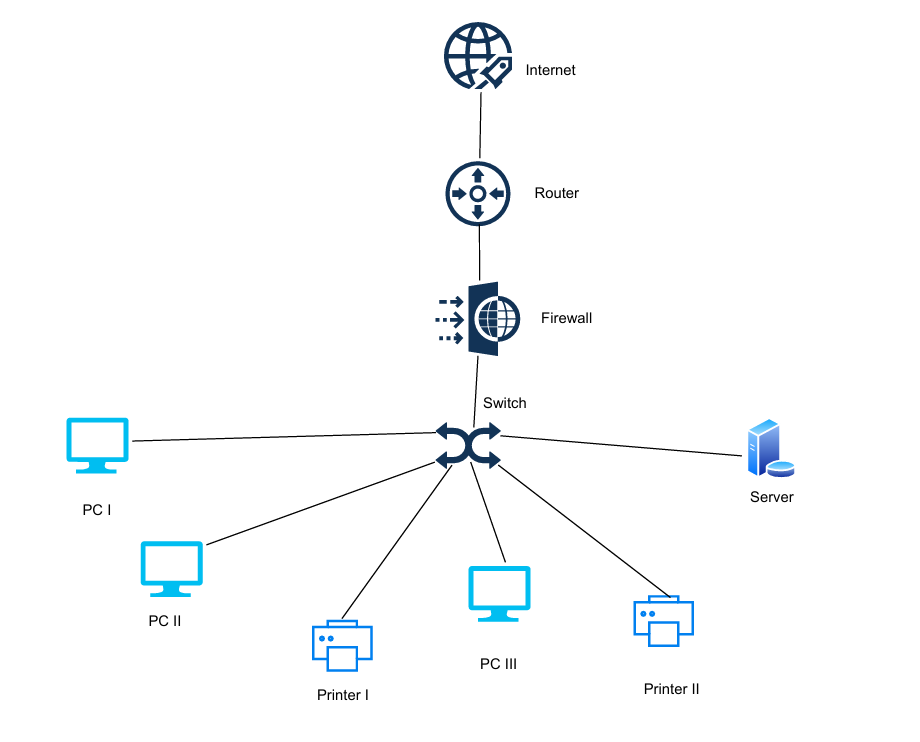
A simplified network model demonstrates the same essential relationship used throughout the larger architecture: endpoints connect through switching infrastructure, traffic passes through security and routing controls, and services are delivered from internal or external resources.

Basic network diagram showing internet router firewall switch computers printers and server

Outcome

Turning infrastructure documentation into actionable recommendations

The completed evaluation connects technical network components to their operational impact. Instead of examining routers, switches, servers, and traffic independently, the project considers how each part affects employee communication, system availability, business continuity, and security.

What this project demonstrates

  • Network architecture analysis
  • OSI model application
  • End-to-end traffic mapping
  • Performance-risk identification
  • Security and segmentation planning
  • Technical diagramming and documentation
  • Infrastructure recommendations based on business needs

References

Supporting sources

Stallings, W. (2015). Foundations of modern networking: SDN, NFV, QoE, IoT, and cloud. Addison-Wesley.

uCertify. (2023). CompTIA Network+ N10-008 course and labs. uCertify.

Software & IT

Explore another systems and technology project.

View Trent College SIS